
Athletes have long relied on how a movement feels. A runner senses a tight hamstring, a hockey player knows one leg feels weaker, and a lifter notices a lift is slower than last month. Objective testing adds numbers to those impressions. Pro Motion Clinic in Kelowna lists VALD force-plate and strength testing among its kinesiology services, a tool aimed at measuring what athletes can otherwise only describe.
Pro Motion Clinic operates from Suite 202, 3030 Pandosy Street in Kelowna, and its site describes a sports and performance orientation that runs through several of its services.
Key Takeaways
- According to the clinic’s own site, Pro Motion Clinic offers VALD force-plate and strength testing under its kinesiology services.
- The clinic also lists athlete performance rehabilitation and golf screening among its services.
- Force-plate testing generally measures how forcefully a person pushes against the ground, which can help compare one side of the body with the other.
- The practical next step: athletes can ask the clinic what a testing session involves, who conducts it and how the results are used.
What the Clinic Says About VALD Testing
The clinic’s site has a dedicated page for VALD testing in Kelowna under its kinesiology section, describing force-plate and strength testing. That information comes from the clinic’s own site, so it is best read as the clinic’s description of what it offers. The site does not name the specific device model, so patients who want details can ask what equipment is used and how sessions run.
Staffing for kinesiology is also a question worth asking. The clinic’s site describes some of its chiropractors as holding both chiropractic and kinesiology designations, and patients can ask who would conduct and interpret a testing session.
What Force-Plate Testing Generally Measures
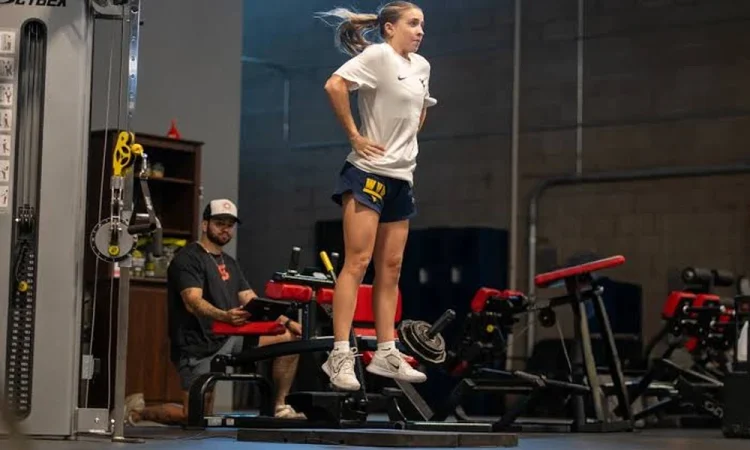
A force plate is a platform that records the force a person applies to it. In general, athletes might perform a jump, a squat or a balance task on the plates, and the system records how much force they produce, how quickly they produce it and how evenly it is distributed between the left and right legs.
Practitioners often use this kind of information in two ways. After an injury, a comparison between the injured and uninjured sides can show how much strength and power remains to be rebuilt. For athletes who are healthy, repeated testing over time can show whether training is changing their output. The results are one input among several and do not replace a clinical assessment.
Part of a Broader Performance Offering
Testing is only one part of the clinic’s sports orientation. Its site lists a standalone page for performance rehabilitation for professional and competitive athletes, golf screening and sports massage therapy. It also describes on-site crews at endurance races, strength competitions and golf clinics, with a recovery space, and practitioners who work with hockey and varsity programs.
Those descriptions come from the clinic. Patients who want to know which events and programs the clinic currently works with can ask directly.
Who Might Consider Testing
Testing may be of interest to competitive athletes, recreational athletes returning from injury and active people curious about imbalances between sides. It is not necessary for everyone, and whether it is useful depends on the person’s goals. A practitioner can say whether testing fits a given situation, and some people may be better served by a standard assessment.
Questions to Ask Before Booking a Session
Athletes can ask what movements are tested, how long a session takes, how the results are explained and whether the clinic can repeat the test later for comparison. It is also reasonable to ask what the session costs, because pricing can vary between services. Clear answers help athletes decide whether the investment makes sense.
A Single Location in Pandosy Village
The clinic is at Suite 202, 3030 Pandosy Street, Kelowna, which its site places in Pandosy Village. Booking runs through the clinic’s JaneApp portal. The clinic lists practitioners across chiropractic, physiotherapy and registered massage therapy, and patients can confirm each practitioner’s registration on the relevant BC college register.
Keeping Expectations Realistic
Testing generates information, not results. Numbers on a screen do not make an athlete stronger, and they cannot predict how any one person will respond to treatment. Their value lies in what a practitioner and athlete do with them next. Patients should treat any testing offer as one tool within a broader plan.
Learning More in Kelowna
Okanagan athletes who want to understand what the clinic’s testing involves can learn about VALD testing on the clinic’s site and then contact Pro Motion Clinic to ask about booking a session.