

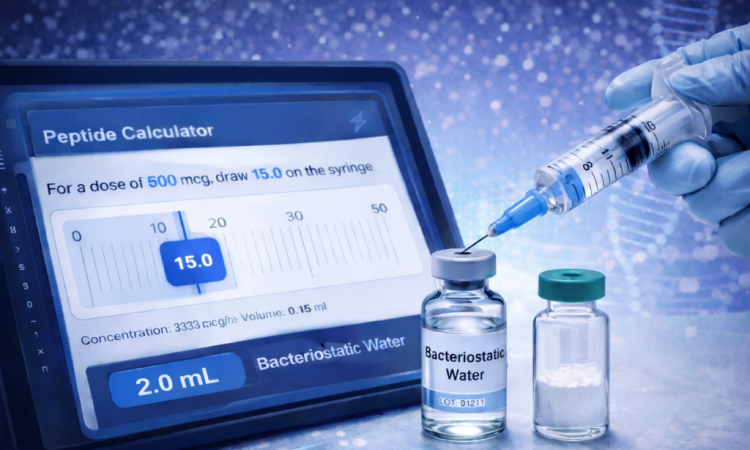
Proper peptide reconstitution is one of the most important steps in preparing peptides for research applications. Accurate calculations help establish the correct concentration after a peptide has been mixed with bacteriostatic water, making it easier to determine the required volume for a specific dosage. While manual calculations can be time-consuming and prone to error, a peptide calculator streamlines the process by providing quick and reliable results.
For researchers handling different peptide strengths and reconstitution volumes, understanding the calculation process helps improve consistency and minimizes mistakes. OZPEP offers the peptide calculator available at https://ozpep.com/peptide-calculator/, providing a convenient way to calculate peptide concentrations and dosage measurements with greater accuracy.
What Is Peptide Reconstitution?
Peptide reconstitution refers to the process of adding an appropriate amount of bacteriostatic water or another suitable diluent to a lyophilized peptide. This transforms the peptide into a liquid solution that can be measured accurately for research purposes.
The concentration of the final solution depends on two primary factors:
- The amount of peptide contained in the vial.
- The total volume of diluent added during reconstitution.
Once these values are established, researchers can determine how much solution corresponds to a desired dosage.
Because every peptide vial may contain different quantities, accurate calculations are essential for achieving consistent preparation.
How a Peptide Calculator Works
A peptide calculator simplifies mathematical calculations by automatically determining peptide concentration after the required values are entered. Instead of manually calculating multiple formulas, users simply provide the necessary information and receive immediate results.
Most peptide calculators require information such as:
- Peptide quantity.
- Volume of bacteriostatic water added.
- Desired dosage.
- Preferred measurement units.
Using these values, the calculator determines the resulting concentration and calculates the volume needed to achieve the selected dosage.
This automated process helps eliminate unnecessary calculations while reducing the likelihood of human error.
Steps for Accurate Reconstitution Calculations
Although digital tools make calculations much easier, understanding the basic workflow improves confidence during peptide preparation.
Step 1: Verify the Peptide Quantity
Begin by confirming the amount of peptide supplied in the vial. This value serves as the foundation for every calculation and should always be checked carefully before proceeding.
Step 2: Record the Reconstitution Volume
Next, determine how much bacteriostatic water will be added. The selected volume directly influences the concentration of the finished solution.
Adding more liquid produces a lower concentration, while using less liquid creates a more concentrated solution.
Step 3: Select the Desired Dosage
Identify the amount of peptide required for each measurement. Entering the intended dosage allows the calculator to determine the exact solution volume needed.
Step 4: Review the Results
After entering all values, carefully review the calculated concentration and dosage measurements before beginning any preparation.
Double-checking the information helps ensure accuracy and consistency.
Common Calculation Mistakes to Avoid
Manual calculations often introduce avoidable mistakes that can affect peptide concentration. Even small errors may produce incorrect dosage measurements.
Some common mistakes include:
- Entering the wrong peptide quantity.
- Selecting an incorrect reconstitution volume.
- Mixing measurement units.
- Misplacing decimal points.
- Forgetting to verify calculations before preparation.
Using a peptide calculator significantly reduces these risks by performing calculations automatically once the correct values have been entered.
Benefits of Accurate Calculations
Accurate peptide calculations contribute to a more organized and consistent preparation process. Reliable concentration values help researchers maintain standardized methods while reducing unnecessary repetition.
Some important benefits include:
- Improved preparation consistency.
- Reduced mathematical errors.
- Faster calculation process.
- Better workflow efficiency.
- Greater confidence in concentration measurements.
- Easier comparison between different peptide preparations.
These advantages become especially valuable when working with multiple peptide strengths or preparing several solutions.
Why Digital Calculation Tools Are Valuable
Digital peptide calculators have become useful resources because they simplify calculations that would otherwise require multiple mathematical steps. Rather than manually converting values, users receive immediate results that are easier to verify.
A well-designed calculator also allows adjustments whenever peptide quantities or reconstitution volumes change, making preparation more flexible without increasing calculation complexity.
By minimizing manual work, digital tools help researchers focus on preparation accuracy instead of repetitive arithmetic.
Conclusion
Proper peptide reconstitution begins with accurate concentration calculations. Understanding how peptide quantity, reconstitution volume, and desired dosage interact provides the foundation for consistent preparation. While manual calculations remain possible, digital peptide calculators make the process faster, simpler, and significantly more reliable.
By carefully verifying input values and using an accurate calculation tool, researchers can improve preparation consistency, reduce common mathematical errors, and establish standardized workflows that support dependable research outcomes.