
What actually combines?
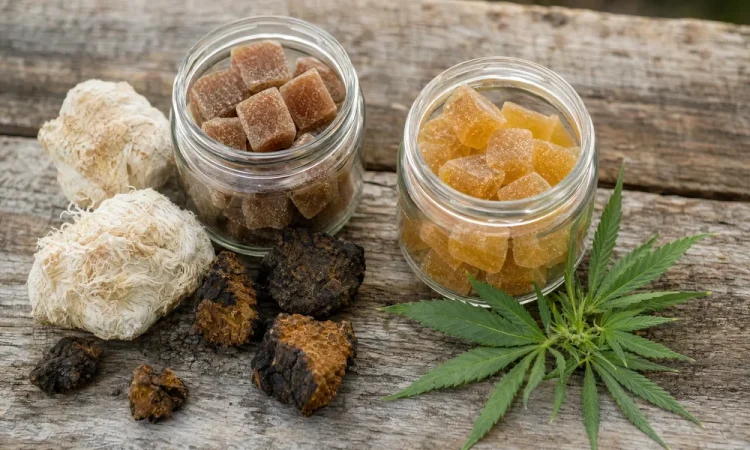
Two ingredient categories sit inside these preparations, cannabis extract beside powdered functional fungi. Psilocybin plays no part in regulated retail versions.
Naming is confusing regularly. Lion’s mane, reishi, cordyceps, and chaga appear across most formulations, each carrying culinary and traditional use stretching back centuries. Nothing psychoactive originates from that side of a blend.
Anything labelled thc and mushroom gummies draws its psychoactive portion entirely from cannabis. Fungal material contributes beta-glucans, triterpenes, and assorted polysaccharides instead. The extraction method decides how much reaches a finished piece, since raw powder and concentrated extract differ enormously in composition. Fruiting body preparations separate from mycelium grown upon grain, because grain content dilutes active compounds considerably. The quantity of fungal powder inside one piece also stays modest compared to portions used across published research. Neither seller’s name leaves a buyer estimating.
How do effects overlap?
Overlap stays limited, since cannabinoids act upon receptors that fungal compounds never reach. Reported combined outcomes, therefore, trace mainly to a cannabis portion.
Timescale separates them further. THC produces a noticeable response within hours, while research examining lion’s mane or reishi measures outcomes across weeks of daily intake. Anyone expecting fungal contribution during one evening misreads how those studies were built.
Formulators nonetheless pair both deliberately. Reishi appears inside evening blends alongside sedating cannabinoid ratios, while cordyceps and lion’s mane populate daytime versions. Logic behind that pairing rests upon traditional categorisation more than upon trial evidence covering any combination directly. Published work examining both together is largely absent.
Combined onset behaviour
Digestion handles both ingredient categories along one route, though arrival differs sharply between them.
- Chewing releases fungal powder and cannabis extract simultaneously into the stomach.
- Fat-soluble cannabinoids wait upon bile before absorption begins properly.
- Noticeable cannabis response commonly lands between forty-five and ninety minutes.
- Fungal compounds absorb quietly without producing anything perceptible across that window.
- Duration then follows a cannabinoid curve alone, running several hours afterwards.
Meals eaten shortly beforehand stretch onset further toward its longer end. Anything noticed across one evening belongs to a THC portion. Crediting alertness or calm toward fungal content inside that timeframe overstates what current evidence supports.
Tracking combined response
Written notes over a fortnight separate genuine patterns from ordinary daily variation.
- Serving hours logged consistently, since timing moves cannabis response more than quantity does for many people.
- Fungal quantity, recorded in milligrams, because published research measures intake across weeks rather than single evenings.
- Cannabinoid content is noted separately from whatever combined total appears upon packaging.
- Morning condition, scored, giving a second reference point beside any evening impression.
Batch-specific certificates confirm cannabinoid quantities independently, provided a printed code matches whatever a seller publishes. Fungal material receives testing far less often, so beta-glucan figures appear rarely upon documentation. Sellers’ publishing both give a buyer something workable.
Combining cannabis with functional fungi produces a cannabis experience carrying a supplementary ingredient rather than a hybrid one. Fungal research runs across weeks while cannabinoid response arrives within an hour, and reading label detail against those separate timescales keeps expectations proportionate. Prescribed medication, immune conditions, and pregnancy each warrant a clinician conversation beforehand.